Maintenance · Dallas, Texas
Pool Gate Won't Close or Latch by Itself in Dallas: Fix It or Replace It?
A 5-minute test, the nine usual causes and when a pool gate can be repaired instead of replaced.
 By Jack Johnson, owner of Park Cities Fence & Deck · · 11 min read · 2,824 words
In short
Usually it can be fixed. Most pool gates that stop closing or latching need the hinge spring tightened, the latch lined up with its strike again, or worn hardware replaced. A leaning post or a bent frame needs a rebuild. Replacing the whole gate is the honest answer only when the gate itself is failing. Until it closes and latches by itself every time, keep it locked.
In this guide
- Can a pool gate that will not close or latch be fixed?
- How do I test my pool gate in five minutes?
- Why did my pool gate stop closing or latching?
- What can I adjust on a pool gate myself?
- Why do pool gates in North Texas drift out of line?
- What needs a rebuild, and when is a new gate the honest answer?
- What do the rules expect of a pool gate in Dallas?
- Does Texas law require my pool gate to self-close and self-latch?
- What do we do when you call about a pool gate?
Need this done? See gate repair.
A pool gate has one job: to shut and catch behind whoever walked through it last. When it stops doing that, the fence around it stops working too. The U.S. Consumer Product Safety Commission puts it plainly in its pool barrier guidelines: the weak link in the strongest and highest fence is a gate that fails to close and latch completely.
We are Park Cities Fence & Deck, a Dallas company that builds pool fencing and handles gate repair across North Texas. This guide is the repair answer: how to test the gate, what each symptom means, what you can adjust yourself and when a rebuild or a new gate is the right call. The rules for a new fence are in our Dallas pool fence code guide. This is general information, not a code ruling.
Can a pool gate that will not close or latch be fixed?
In most cases, yes. A gate that used to work and now does not has usually moved a little or worn a little. The hinge spring has lost tension, the latch has drifted away from its strike, or the hardware has corroded beside the water. Those are repairs, not a new fence.
The repair gets bigger when the cause is below the hardware. If the post the gate hangs on is leaning, or the gate frame has bent or racked out of square, no adjustment will hold. The post has to be reset or the gate rebuilt. Replacement comes last.
Until the gate passes the test below, lock it. The CPSC guidelines say every pool gate should have a locking device, and a locked gate is the one stopgap that works. A bungee cord, a brick or a note on the gate is not a barrier.
How do I test my pool gate in five minutes?
Stand on the outside of the gate, the side a child would come from, and run these checks in order. You need only a tape measure. Keep children away while you test.
The City of Dallas writes the range down for hotel and similar public pools: the latch must catch when the gate is let go anywhere from fully open to 6 inches from fully closed. That section is not written for a backyard, but it is a sound standard for your own test: a gate released close to the latch has the least momentum.
- Wide openOpen the gate as far as it goes and let go. Do not push. It should swing shut and latch with a clear click.
- HalfwayOpen it to about half and let go. Same result, every time.
- A hand's widthOpen it about 6 inches and let go. This is where a weak spring or a misaligned latch shows up first.
- RepeatRun each position three times. One miss in nine is a failed test.
- Pull testWith the gate latched, pull and push on it firmly without touching the release. It should stay shut and should not rattle free.
- Direction and reachCheck that the gate swings away from the pool, then measure the height of the latch release and the gap under the gate. The numbers are in the rules section below.
Why did my pool gate stop closing or latching?
Match what you see to the table. Most gates have one cause. A gate ignored for a few seasons often has two: a post that moved and hardware forced to compensate.
To find the cause, open the gate and lift the latch side gently by hand. If the hinge shifts against the post, the fasteners are loose. If the gate changes shape, the frame has racked. If the post itself moves, the problem is in the ground. Our guide to why wood gates sag walks through that lift test for cedar gates in more detail.
| What you see | Likely cause | The fix |
|---|---|---|
| Gate drags on the deck or sags on the latch side | Loose hinge fasteners, a racked frame or a hinge post that has tilted | Tighten or through-bolt the hinges. If the frame or post moved, that is a rebuild. |
| Latch and strike no longer line up | The post or the gate has shifted a fraction of an inch, often with the season | Move the latch or strike on its slots. If it drifts again within months, look at the post. |
| Gate closes slowly or stops short of the latch | Hinge spring has lost tension or is worn out | Add tension by the hinge maker's instructions. Replace hinges that will not hold it. |
| Gate slams, then bounces back open | Too much spring tension, or no control over closing speed | Back the tension off until it closes firmly without rebounding. Replace hinges that cannot be set. |
| Latch sticks, grinds or will not release cleanly | Corrosion or grit in the latch from pool splash and weather | Clean and test it. A latch that still sticks is replaced, not oiled and trusted. |
| Post leans, or the gap beside the gate is wider at the top than the bottom | Clay soil movement or a failed footing | Reset the post in a deeper concrete footing. No hardware adjustment fixes a moving post. |
| Gate swings in toward the pool | Hung the wrong way when it was built or after an earlier repair | Rehang it to open outward, away from the pool, and reposition the latch to suit. |
| Latch is low, or a hand can reach it through the pickets | Hardware mounted for convenience, not for a child's reach | Raise the release or move it to the pool side and close off openings near it. |
| A gap has opened under the gate | The ground settled, washed out or shrank away from the bottom rail | Regrade or add a threshold under the gate, or lower the gate if the hinges allow. |
What this means for you: The first five rows are hardware, the smaller end of the job. The last four are about position, where the post stands or where the gate and latch sit, and those can fail an inspection even when the gate closes perfectly.
What can I adjust on a pool gate myself?
Two things, if your hardware was made to be adjusted: the closing tension of the hinges and the position of the latch. Make one small change at a time and run the full test after each.
Stop when a second adjustment has not fixed it. A gate that needs more and more spring to reach the latch is telling you something else has moved.
- Hinge spring tension: Most self-closing hinges have a tension setting. Follow the maker's instructions for your hinge, use the tool it calls for, and set both hinges the same. The spring is under load, so keep fingers clear, and if you cannot tell how the hinge adjusts, leave it.
- Latch alignment: Many latches and strikes sit on slotted holes. Loosen the screws, slide the part until the latch meets the strike squarely with the gate closed, tighten, then test from all three positions.
- Loose fasteners: Tighten hinge and latch screws that have backed out. A screw that spins without biting has stripped its hole and needs a larger fastener or a through-bolt.
- Cleaning: Rinse grit and pool residue off the latch and hinges. Our iron fence rust guide covers the coating around them.
- What not to do: Do not bend the latch to reach, grind the strike, shim the gate with washers or add a second spring. Each makes a gate that passes today and fails when the season changes.
Why do pool gates in North Texas drift out of line?
Because the ground under the posts does not hold still. North Texas clay swells when it is wet and shrinks when it dries. A post set shallow in that clay tilts a little one way in a dry summer and a little back after a wet spring. A gate latch has very little tolerance, so a small lean at the base of a post becomes a clear miss at latch height.
That is why we treat a latch that drifts every season as a post problem, not a latch problem. The same shrinkage opens a gap under a gate that was built tight. The lasting answer is a footing set below the zone where the clay moves, as our guide to post depth and concrete in clay soil explains. The soil is the same story from North Dallas to Plano and Colleyville.
What needs a rebuild, and when is a new gate the honest answer?
A rebuild means the fix is in the structure, not the hardware. There are two kinds. A post reset takes the gate off, digs out the failed footing, sets the post plumb in new concrete at the right depth and rehangs the gate. A frame repair squares or replaces the gate leaf while the posts stay. Either can leave you with the same gate, working properly.
We recommend replacing the gate when repair would not last or would not make it safe. In practice that is one of four situations.
If only the gate is failing and the fence is sound, replace only the gate. We build ornamental iron and steel in-house, so a new gate can be made to suit the fence it hangs in. If the fence has the same problems along its length, our guide to repairing versus replacing a fence will help you weigh it.
- The frame is rusted through or cracked: Rust at the hinge side or the bottom rail of a steel gate, or rot in the frame of a wood gate, means new hardware has nothing solid to hold on to.
- The gate cannot meet the barrier rules as built: It is too short, the pickets are too far apart, or its rails make a ladder on the outside. No latch fixes that.
- It was never built to self-close: Some older gates are too heavy or too flexible for self-closing hinges to control. Rebuilding on a rigid frame is the reliable route.
- It has been repaired again and again: Several rounds of shims, extra springs and moved latches usually cost more than one properly built gate.

What do the rules expect of a pool gate in Dallas?
Three things, in every document we read: the gate opens outward, away from the pool, it closes by itself and it latches by itself. The differences are in the latch height.
City of Dallas. Chapter 62 of the Dallas City Code adopts the 2021 International Swimming Pool and Spa Code with local changes. Section 305.9.1 says every owner, tenant or other person in possession of a lot with a pool shall at all times maintain a fence, wall or barrier that completely surrounds it. Section 305.2.1 limits the clearance under the barrier to 2 inches over grass or gravel and 4 inches over a solid surface such as concrete. The Dallas ordinance does not list a change to the model code's gate section, 305.3.
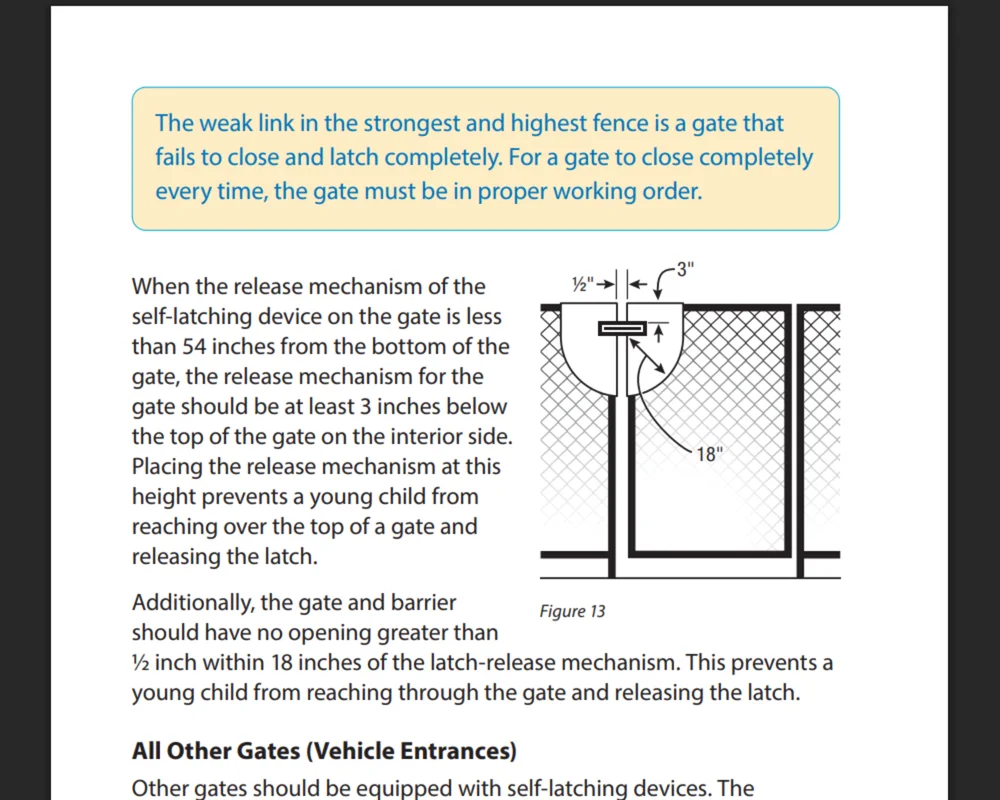
The model code, Section 305.3. Gates must be able to take a lock. Pedestrian gates open outward away from the pool, are self-closing and have a self-latching device. At a residential pool, a latch release reached from outside the fence, unless it is the self-locking type worked by a key or code, sits at least 54 inches above the ground. If the only release is on the pool side, it sits at least 3 inches below the top of the gate, and no opening within 18 inches of it may be larger than half an inch. We read this wording in the Town of Prosper's official reprint of the 2021 code, because the publisher's own site would not open for us.
CPSC guidelines. The federal guidelines are voluntary, and they say the same about direction, closing and latching. They measure the 54 inches from the bottom of the gate, not from the ground, so the two documents differ slightly on a gate that sits above grade. Plano prints the same gate wording in its pool permit requirements and adds that when only the fence is replaced at an existing pool, the new fence has to comply. Other cities are in our pool fence rules by city guide. We did not find a published gate handout for Colleyville, so there we confirm with the city before changing a gate.
Does Texas law require my pool gate to self-close and self-latch?
The state statute does not reach a single-family home. The law people quote, Texas Health and Safety Code Chapter 757, says in Section 757.002 that it applies only to a pool owned, controlled or maintained by the owner of a multiunit rental complex or by a property owners association, and to the doors and windows of rental dwellings that open into such a pool yard. Its definition of a multiunit rental complex excludes a single-family home. For your own backyard pool, the rule comes from your city.
If you sit on an HOA board or manage a rental community, Chapter 757 is your rule and it is specific. Section 757.004 requires a gate with a self-closing and self-latching device, hardware that lets it be locked, and an outward swing. The latch goes at least 60 inches above the ground, unless it is on the pool yard side, at least 3 inches below the top of the gate, with no opening over half an inch within 18 inches, or unless the gate opens only by key, card or combination from both sides, when 42 inches is allowed. Section 757.009 requires the owner or association to inspect the enclosure, gates and self-closing and self-latching devices no less than once every 31 days, and to keep them in good working order.
Two other parties may look at your gate. An insurer may ask about the pool barrier when it writes or renews a home policy, and a buyer's inspector may note a pool gate that does not close and latch. What each one expects is set by that insurer or that contract, not by a single rule, so ask your agent in writing. Our guide to the best pool fence for families covers the insurance questions to ask.
What do we do when you call about a pool gate?
Owner Jack Johnson comes out himself. He runs the same test you did, then checks the post for plumb, the frame for square, the hinges, the latch height, the swing direction and the gap underneath. You get a free written estimate that says which of the three levels your gate needs: an adjustment, new hardware, or a post reset or new gate.
When a rebuild is needed, we set gate posts in concrete on footings engineered to sit below the clay movement zone, and we build gate frames in powder-coated ornamental steel. If the fix belongs with a wider fence repair, it is quoted on the same estimate. We confirm your city's current gate requirement before we change the hardware, and Jack is on site for the work and the final walkthrough, where the gate is tested from every position in front of you.
Call (214) 755-8100 or request a free written estimate. If the gate is not latching today, lock it now and call us after.
How Park Cities Fence & Deck helps
Jack Johnson comes out himself, looks at your property and gives you a free written estimate with a timeline. Wood, iron and masonry are all built in-house, so the advice fits the property. Related services: gate repair, pool fencing, fence rehab / repair. We work in Plano and North Dallas and across Dallas.
Questions people ask next
How often should I test my pool gate?
We suggest once a month in swimming season and after any long dry spell or heavy rain, because that is when clay soil moves posts. Texas law sets a schedule only for apartment and association pools: Section 757.009 requires those owners to inspect gates and their self-closing and self-latching devices no less than once every 31 days.
Can I padlock the gate instead of fixing the latch?
As a stopgap, yes, and you should. As a fix, no. The CPSC guidelines and the model pool code both expect a gate that can be locked and that also closes and latches by itself. A padlock protects only when someone remembers it.
Does a double gate into the pool yard have to latch by itself?
Under Section 305.3.2 of the 2021 International Swimming Pool and Spa Code, a double gate needs at least one leaf secured in place and the other leaf secured with a self-latching device. Section 305.3.1 adds that gates not meant for people on foot, such as utility or service gates, stay locked when not in use. Confirm how your city applies both.
Do I need a permit to repair or replace a pool gate in Dallas?
We could not find a City of Dallas page that answers this for a gate alone, so we confirm it with the city for each job. Plano states that fences surrounding residential pools require separate permits and that a replaced fence at an existing pool must meet the pool barrier requirements. Ask your city before work starts, or let us ask.
Sources and further reading
- U.S. Consumer Product Safety Commission: Safety Barrier Guidelines for Residential Pools (Pub. 362, April 2023)
- City of Dallas: Ordinance 32197, Chapter 62, Dallas Swimming Pool and Spa Code (2021 International Swimming Pool and Spa Code with Dallas amendments, Section 305)
- Town of Prosper: Pool/Spa Barrier Requirements, 2021 ISPSC with adopted amendments (reprint of Section 305.3, Doors and gates)
- City of Plano Building Inspections: Swimming Pool and Spa Permit Requirements
- Texas Health and Safety Code, Chapter 757: Pool Yard Enclosures (Sections 757.001, 757.002, 757.004, 757.009)
General information, not legal advice. Rules change: we confirm the current requirements with your city or HOA before we build.