Gates · Dallas, Texas
How Do Exit Loops and Vehicle Detection Work on a Dallas Driveway Gate?
Free-exit, reversing and shadow loops in plain words, plus the options when a Dallas driveway cannot be cut.
 By Jack Johnson, owner of Park Cities Fence & Deck · · 10 min read · 2,818 words
In short
You add up to three wire loops in or under the driveway, each wired to a detector at the gate operator: a free-exit loop well inside the gate that opens it as you leave, reversing loops beside the gate that keep it from closing on a car, and on a swing gate a shadow loop under the swing path. Where the driveway cannot be cut, a buried probe can handle free exit only.
In this guide
- What does vehicle detection do on a driveway gate?
- How do an inductive loop and its detector work?
- Where does each loop go on a slide gate and on a swing gate?
- Saw-cut loop or preformed loop: which one fits my driveway?
- What if the driveway cannot be cut?
- What goes wrong with driveway gate loops?
- Why do cracked driveways and North Texas clay make loops fail?
- Should loops be added to an existing gate or planned into a new driveway?
- Do loops count toward the UL 325 safety requirements?
- How do we plan vehicle detection on a gate in Dallas?
Need this done? See gates & gate motors.
A remote, a keypad and a phone app all ask the driver to do something. Vehicle detection does not. The gate opens because your car is rolling toward it, and it stays open because a car is still in the opening.
We are Park Cities Fence & Deck, a Dallas company that builds automatic driveway gates and repairs gates and openers across Preston Hollow, the Park Cities and North Texas. The distances and sizes below come from manufacturers' published installation documents, listed at the end. They are examples, and naming a document is not a recommendation of that brand. The manual for your own operator and detector governs.
What does vehicle detection do on a driveway gate?
It does three separate jobs, and each job has its own loop in its own place. One manufacturer's guide, DoorKing's Underground Loops and Loop Detectors Information Manual, describes a loop system as a way to keep a gate from automatically closing on a vehicle, or to open the gate automatically when a vehicle is leaving.
- Free-exit loop: Sits inside the property, well back from the gate. A car heading for the street crosses it and the gate opens. No remote, no code.
- Reversing loops: Often called safety loops. One sits just inside the gate and one just outside. While a vehicle is over either, the gate will not close, and a closing gate reverses.
- Shadow loop: For swing gates. It lies under the path the leaf swings through, so an open gate does not start closing on a car stopped between the two reversing loops.
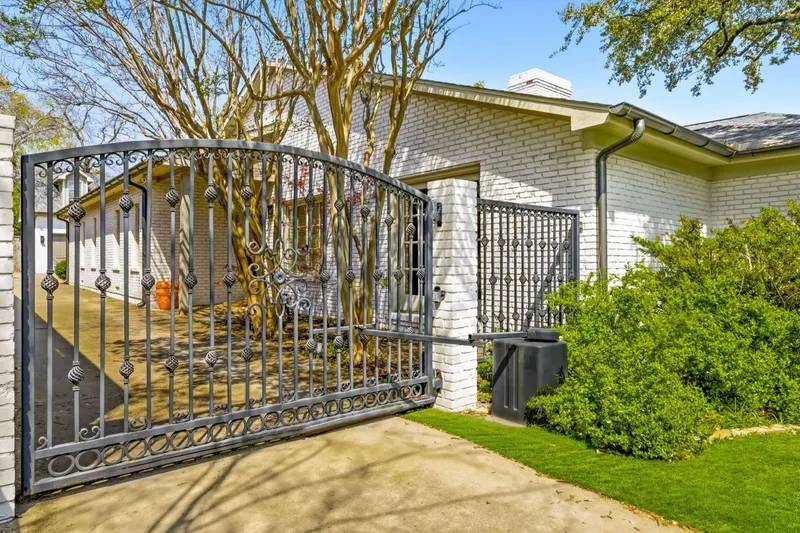
How do an inductive loop and its detector work?
A loop is a coil of wire in the pavement. The detector, a small electronic module at the gate operator, sets up an electrical field around that coil. When a large metal object rolls into the field, the field changes, and the detector switches a relay that tells the operator to open, hold or reverse.
The DoorKing manual lists three parts: the underground loop, the lead-in wire that carries its two ends back to the operator, and the detector. The loop is one continuous piece of wire, with no splices, wound several turns in a square or rectangle. The manual adds that most detector problems are caused by improper loop installation.
Size decides what the loop can see. That manual gives the height of detection as roughly one half to two thirds of the loop's short side: a 4 by 8 foot loop detects to about 2 1/2 feet above the pavement, a 6 by 8 foot loop to about 4 feet, and the short side should never be under 18 inches. So tell your installer about every vehicle that uses the driveway. For the rest of the hardware, see our guide to gate motors, keypads, remotes and safety sensors.
Where does each loop go on a slide gate and on a swing gate?
The free-exit loop goes far enough inside that the gate is already moving when you reach it. The DoorKing manual says an exit loop is "normally located 20-100 feet away from the gate so that the gate is open or opening as you drive up to it," on its own detector. A short University Park driveway may not have 20 feet inside the gate, so the loop goes as far back as the layout allows and you accept a brief pause.
On a slide gate, the manual calls for two reversing loops, one on each side, wired to a single detector so the steel gate can slide between them without being read as a car. It warns not to place a loop closer to the gate than the length of the loop's short side, or the moving gate will disturb the field and reverse mid-cycle. Its simplified rule: at least 4 feet from the gate and from each other.
On a swing gate, the reversing loops sit outside the arc of the leaves, or the leaves would trip them. That leaves an uncovered patch of driveway exactly where the gate swings, and the shadow loop covers it. The operator listens to the shadow loop only when the gate is fully open and ignores it once closing begins. Gate type changes the layout, one more reason to settle swing or slide before the driveway is finished.
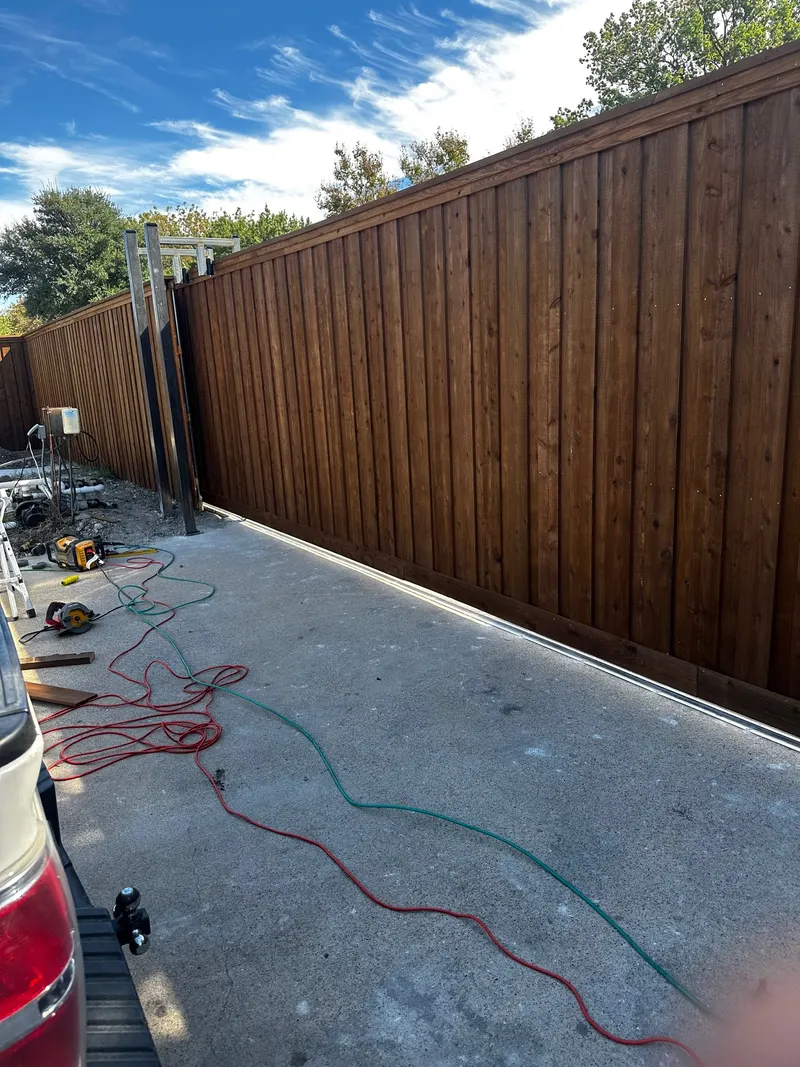
Saw-cut loop or preformed loop: which one fits my driveway?
If the driveway exists, the loop is saw cut into it. If the driveway is about to be poured or laid, a preformed loop goes in first and nothing is cut. The DoorKing manual says loops can be saw cut into concrete or asphalt, placed under brick pavers and asphalt, or embedded in poured concrete.
Saw-cut loops. A narrow slot is cut in a rectangle with angled corners. The wire is laid in, held down with foam backer rod and sealed flush. The manual shows a slot 3/16 to 1/4 inch wide, typically 1 1/2 inches deep for one to three turns of wire and 2 inches for four to six. It adds a guideline that matters on a residential slab: try not to cut deeper than half the pavement thickness, because too deep a cut can crack over time. The sealed outline stays visible, so on decorative concrete ask where the lines will fall.
Preformed loops. These are factory-made loops in a protective jacket, staked in place before the surface goes on. For poured concrete, the manual says to embed them 2 to 3 inches below the surface, keep the loop off the rebar and cut mesh or reinforcement back at least 6 inches from the loop's perimeter. Under asphalt, the maker's preformed loop sheet calls for at least 1 inch of sand or soil over the loop. Neither document gives a depth for pavers, so there the instructions packed with the specific loop apply.
What if the driveway cannot be cut?
Free exit is still possible on stamped concrete or old brick, with a different device and different limits.
Buried magnetic probe, often called an exit wand. A sealed probe is buried beside the driveway and wired to the operator. It senses the disturbance a moving steel vehicle makes in the earth's magnetic field. EMX Industries' manual for its probe gives a range of up to 12 feet at a minimum of 5 mph, burial about 8 to 12 inches deep, and one firm limit: it "will only detect a moving vehicle" and "is not suitable for use as a vehicle presence detector such as a reversing loop." Cartell's instructions for its wired sensor agree: it is not a safety, and external safety must be added. A probe can open the gate. It cannot hold the gate open over a stopped car.
Wireless vehicle sensor. The same sensing with batteries and a radio link in place of the cable. Cartell's manual for its wireless system lists a radio range of at least 350 feet, says to test that range on site first, and suggests keeping the sensor at least 50 feet from the operator where possible. You trade a trench for battery changes.
Photo-eyes. These are not vehicle detection. A photo-eye is a single beam across the opening, installed as entrapment protection for people, as our guide to driveway gate setback, permit and safety rules explains. It only sees what crosses that one line, and it cannot open a gate for you.
| Option | What it detects | Needs a driveway cut? | Best for | Watch out for |
|---|---|---|---|---|
| Saw-cut loop | A vehicle moving or stopped over the loop | Yes, a narrow sealed slot | Sound existing concrete or asphalt; all three loop jobs | Cracks crossing the slot, sealant voids, a visible outline |
| Preformed loop | A vehicle moving or stopped over the loop | No, it goes in before the surface | New driveways and replacements; all three loop jobs | Must be placed and tested before the pour; keep clear of rebar |
| Buried magnetic probe | A moving steel vehicle passing nearby | No, a trench beside the drive | Free exit only, where the surface cannot be touched | Blind to a stopped car; nearby wiring and passing traffic |
| Wireless vehicle sensor | A moving steel vehicle passing nearby | No, or one small bored hole | Free exit only, where trenching is not practical | Batteries, radio range, blind to a stopped car |
| Photo-eyes | Whatever breaks one beam across the opening | No | Entrapment protection for people | Not vehicle detection; cannot open the gate |
What this means for you: Only a loop can tell that a car is sitting still in the gate path, so reversing and shadow duty belong to loops. A probe or wireless sensor is a fair answer for free exit alone. Photo-eyes are on the gate either way.
What goes wrong with driveway gate loops?
No layout makes a gate foolproof, but these failures can be planned around. If your gate is already misbehaving, start with why an automatic gate will not open or close.
- Free exit that sees the street or alley: On a short lot the exit device ends up near the property line. A loop reaches only a few feet, but a probe can reach 12 feet or more, and Cartell's wireless manual advises lowering sensitivity near cross traffic. Otherwise passing cars open your gate.
- A loop too close to a slide gate: Inside the minimum spacing the detector reads the moving steel as a car and the gate reverses by itself.
- A car parked on the exit loop: A loop sees a stopped vehicle, so a guest parked on it can hold the gate open. Put that loop where cars travel, not where they wait.
- Motorcycles and bicycles: The DoorKing manual warns that motorcycles often lack the mass of metal needed to trigger a loop detector. A bicycle has less. Do not rely on a loop to see either.
- High trucks and trailers: Detection height follows the loop's short side, so a small loop can lose a tall truck. Size the loop before the wire goes in.
- Sprinkler and low-voltage lines: EMX's manual says not to run a probe or its cable near or parallel to low-voltage lighting wires or in-ground power lines. Sprinklers matter differently: the DoorKing manual notes that a nicked loop wire works in dry ground and shorts when rain or sprinklers wet it.
Why do cracked driveways and North Texas clay make loops fail?
Because a loop is one unbroken wire in a slab that moves. Dallas-area clay shrinks in a dry summer and swells when rain returns, and driveways crack with it. We set gate and fence footings with that movement in mind, as our guide to post depth in North Texas clay explains. A loop has no footing. It rides near the top of the slab.
When a crack opens across a saw cut and the two sides shift, the wire is stretched or scraped there. A break stops the loop. A nick is harder to find: the gate works for weeks, then acts up after a storm or on watering days. The DoorKing manual describes testing a suspect loop from the wire to earth ground with a megohm meter: above 100 megohms is healthy, under 50 means replace the loop.
Two details from that manual help on our soil. It shows a hole of about 1/2 inch drilled where a loop crosses an expansion joint, so the wire has room to move. And it asks for sealant with no voids, since trapped water works the wire out of the slot. If an older slab is already broken into moving pieces, a preformed loop under a new section or a probe beside the drive is the better choice.
Should loops be added to an existing gate or planned into a new driveway?
Either works, but a new driveway is the one chance to do it invisibly. On an existing gate, loops are saw cut, lead-in wires are run to the operator and detectors are added if the operator accepts them. We look at this on a gate and opener repair visit, and it is one part of what drives the cost of an automatic gate.
On a new build, the usual order in Preston Hollow, the Park Cities and the newer estates in Frisco is house, driveway, then gate, which is backward for loops. Here is what to settle with the concrete or paver contractor, and when.
- Before the driveway is designedDecide swing or slide and fix the gate line. Loop positions are measured from the gate.
- Before the base is finishedHave conduit sleeves laid under the driveway for loop lead-ins, power and the keypad. The DoorKing preformed loop sheet shows the lead-in leaving through 1/2 inch PVC conduit.
- Before steel and mesh are tiedShow the contractor where each loop sits. A heavy rebar grid right under a loop can affect its field, and any change to the steel is the concrete contractor's or engineer's call, not the gate installer's.
- On pour day or paver dayLoops are staked at the depth their instructions give and tested before they are covered. A loop found dead after the pour becomes a saw-cut job.
- After the surface is inNo joints, cores or anchors cut through the loop areas. Keep a marked drawing with the house papers.
Do loops count toward the UL 325 safety requirements?
No. Loops are vehicle detection. UL 325, the safety standard for gate operators, deals with entrapment: a person caught or held in a position that increases the risk of injury. DASMA Technical Data Sheet 353 summarizes the rule. An operator needs at least two independent means of entrapment protection for each entrapment zone, chosen from a short list: the operator's built-in sensing, photoelectric sensors, contact edges, force limiting on swing gates and constant-pressure controls. Vehicle loops are not on it.
The same sheet says external entrapment sensors must be monitored by the operator, and that gate operators are for vehicular gates only, with separate access for people on foot. A complete system has both layers: entrapment devices to protect people, and loops to protect cars. Our guide to security features for a high-end driveway gate shows how the layers fit together.
How do we plan vehicle detection on a gate in Dallas?
We start with how the household uses the driveway: which vehicles, who backs out, where guests park, whether a trailer or tall truck comes through. Jack Johnson comes out himself for the consultation and measures from the gate line, so the loop layout is settled before anything is cut or poured. Safety photo-eyes and battery backup are on every gate motor we install, and loops are planned on top of those, never in their place.
Trenching for lead-ins and probes crosses the same ground as your utilities. We handle the 811 locate, but 811 does not mark private lines such as sprinklers and landscape lighting, so tell us where yours run. Our guide to 811 locates and private lines explains who marks what. For the rest of the system, follow our gate maintenance schedule.
Planning a new custom gate, replacing a driveway, or living with a gate that will not open on the way out? Call (214) 755-8100 or send us the details for a free written estimate.
How Park Cities Fence & Deck helps
Jack Johnson comes out himself, looks at your property and gives you a free written estimate with a timeline. Wood, iron and masonry are all built in-house, so the advice fits the property. Related services: gates & gate motors, gate repair, custom gates. We work in Preston Hollow and University Park and across Dallas.
Questions people ask next
Can a free-exit loop let a stranger in?
A free-exit device opens the gate for any vehicle that reaches it. The protection is placement: the loop or probe sits inside the closed gate, out of reach from the street. A probe reaches farther than a loop, so it should not be buried near the fence line or sidewalk. Visitors arriving from outside still need the keypad, intercom or remote.
Can one loop handle both free exit and reversing?
No. The two jobs sit in different places and send different commands. One manufacturer's loop manual puts the exit loop 20 to 100 feet inside the gate on its own detector, while the reversing loops sit close to the gate. A loop near enough to guard the gate path is too near to have the gate open by the time you arrive.
Will free exit still work during a power outage?
It depends on the operator. Battery backup is on every gate motor we install, but how many cycles you get and which accessories stay live on battery vary by model. Ask to see a full exit cycle on battery power at the final walkthrough, and confirm the behavior in your operator manual.
How do I know a loop has failed?
The usual signs are a gate that no longer opens on the way out, a gate that stays open, or one that reverses with nothing in its path, often worse after rain or watering. Some detectors flash a fault light when the loop circuit has a problem. A technician confirms it by testing the loop wire to ground.
Sources and further reading
- DoorKing: Underground Loops and Loop Detectors Information Manual (Loop Info-S-5-22)
- DoorKing: Preformed Inductive Ground Loop installation sheet (9401-065-D-1-18)
- EMX Industries: VMD202 Single Piece Vehicle Motion Detector Instruction Manual (Rev 3.3)
- Cartell: Installation Instructions for CP-4 Automatic Gate Opener (free-exit sensor)
- Cartell: CW-SYS Dual-Purpose Wireless Driveway System manual (Version 7, January 2025)
- DASMA Technical Data Sheet 353: Vehicular Gate Operators and the ANSI/CAN/UL 325 Standard
General information, not legal advice. Rules change: we confirm the current requirements with your city or HOA before we build.