Local Rules · Dallas, Texas
What Fence Can You Build on a Corner Lot in Dallas, Highland Park or University Park?
Visibility triangle sizes, side-street fence heights and the designs that keep privacy on a corner lot in Dallas and the Park Cities.
 By Jack Johnson, owner of Park Cities Fence & Deck · · 11 min read · 2,742 words
In short
You can fence a corner lot, but not the corner itself. Dallas keeps a triangle measured 45 feet along each curb clear between 2.5 and 8 feet high, University Park uses 35 feet and Highland Park 25 feet. Behind that triangle, where the second street counts as a side yard, the fence can reach 8 feet in the Park Cities and 9 feet in Dallas, so privacy starts a few steps back from the corner.
In this guide
- What makes a corner lot different from the lot next door?
- How big is the visibility triangle in Dallas, Highland Park and University Park?
- Where does the triangle actually land on my lot?
- Which street is my front yard, and how tall can the side-street fence be?
- Are fences allowed in the front setback of a corner property?
- What happens where my driveway or alley meets the side street?
- Which fence design works best on a corner lot while keeping curb appeal?
- Where can the solid privacy run start, and how do slope and planting change it?
- How do we lay out a corner-lot fence before anything is built?
Need this done? See iron / metal fencing.
A corner lot has two street faces, more passing traffic and more of the yard on show. It also has one rule the lot next door never meets: the visibility triangle. Most owners first hear about it when a plan comes back marked up.
We are Park Cities Fence & Deck, and we build cedar, ornamental iron and steel and masonry fences on corner lots in Dallas, Highland Park and University Park. For this guide we read the current code sections of all three and list them at the end. It is general information, not legal advice, and we confirm the rule for your address before we draw anything.
What makes a corner lot different from the lot next door?
Three things. Drivers have to see across your corner, so every city keeps a triangle of ground there free of anything tall. You have two street frontages, and which one is the front yard sets how tall the fence along the other can be. And there are more places where pavement meets pavement: a side-street driveway, an alley at the back corner, sometimes both.
Our guide to fence height rules in Dallas and the Park Cities explains the general pattern. This one gives the numbers for each city and shows how to design around them.
How big is the visibility triangle in Dallas, Highland Park and University Park?
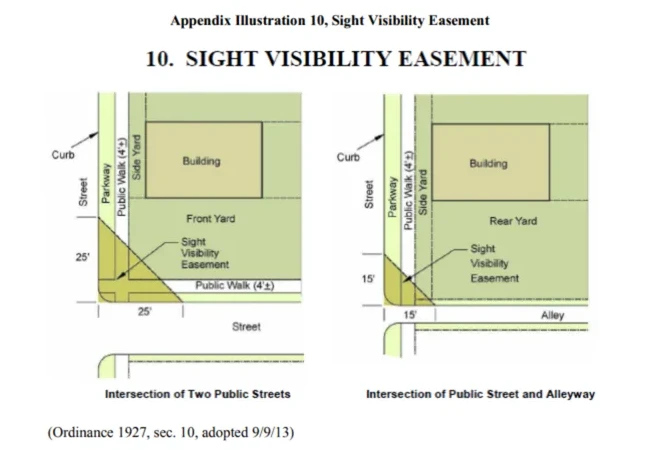
Each city writes its own size, and the three are not close. The Dallas Development Code, Section 51A-4.602(d), defines the triangle on a corner lot by the point where the two street curb lines meet and a point on each curb line 45 feet from it. University Park, in Section 12.01.012 of its Code of Ordinances, connects points 35 feet from the intersection of the extended curblines. Highland Park calls it a sight visibility easement and runs it 25 feet back from the intersection in each direction along the curbline.
Inside that area the rule is about height, and not only about fences. Dallas bars any structure, berm, plant life or other item between two and a half and eight feet high, measured from the top of the adjacent street curb. University Park uses the same band and names fences, walls, screens, hedges, trees and shrubs. Highland Park starts lower, at 24 inches above the top of the curb.
| City and section | Triangle where two streets meet | Where an alley or driveway meets the street | What may stand inside it | Side-street yard fence limit |
|---|---|---|---|---|
| Dallas: Sections 51A-4.602 and 51A-4.401 | 45 feet along each curb line (30 feet in central area districts and two named planned development districts) | 20 feet along the driveway or alley edge and 20 feet along the curb | Only what is under 2.5 feet or over 8 feet above the top of the street curb | 9 feet where side yard rules govern; 4 feet where it is a required front yard |
| Highland Park: Zoning Ordinance Sections 15-101, 15-102 and 8-502(5) | 25 feet each way along the street curbline | Alley: 15 feet each way. No driveway distance in the sections we read | Nothing in the line of sight from 24 inches to 8 feet above the top of the curb | 8 feet from the non-owner side where it is a side yard; no fence where it is treated as a front yard |
| University Park: Code Section 12.01.012, Zoning Ordinance Sections 8.2.3 and 8.4 | 35 feet along each curbline | Alley: 15 feet in both directions. No driveway distance in the sections we read | Nothing in the sight line between 2.5 and 8 feet above the top of the street curbline | 8 feet along a street side lot line, never forward of the front wall of the house |
What this means for you: The same corner fence can be legal in one city and 20 feet too long in the next. Find your city's row, then read the last column, because the side-street limit decides how much privacy the rest of the yard can have.
Where does the triangle actually land on my lot?
Closer to the street than most people fear. All three cities measure along the curb, not along your property line. Between the curb and your lot there is normally a strip of public ground, the parkway and the sidewalk, and the first part of the triangle lies there.
Here is a worked example, not a code number. Take a square corner where the property line sits 10 feet behind the curb on both streets. In Dallas the long edge of a 45-foot triangle crosses each property line 25 feet from the lot corner: 45 minus 10 minus 10. In University Park the same lot loses 15 feet along each line, and in Highland Park about 5 feet. Your distances will differ, which is why we measure them on site with the survey in hand.
Height is measured from the curb too. If your lawn sits above the street, a low wall or a planting bed that looks harmless from the yard can still rise into the band that starts two and a half feet above the curb. On raised corner lots we check that with a level.
Two official Dallas documents disagree here. The city's online Planning & Development Guide gives the triangle as 30 feet along each curb. The code gives 30 feet only for central area districts and two named planned development districts, and 45 feet everywhere else. We design to the code and confirm with the plan reviewer.
Which street is my front yard, and how tall can the side-street fence be?
In Dallas the front door does not decide it. Section 51A-4.401(b)(1) says that on a corner lot in a single family or duplex district, the shorter street frontage follows the front yard rules and the longer one follows the side yard rules. If the two are equal, one is front and one is side. The fence standards cap a fence at four feet in the required front yard, except where that yard is governed by the side or rear yard rules, and at nine feet in any required yard.
So on many Dallas corner lots the long side-street run can be a full privacy fence. Read the end of that paragraph with care, though: the continuity of the established setback along the street frontage must be maintained. Where the houses behind you face your side street, the city may hold part of your side yard to their front setback, and the four-foot limit can come with it. That is the city's call for your lot, and we ask before we draw. Planned development and conservation districts can set their own numbers.
University Park is simpler. Section 8.4.2 of its zoning ordinance allows a fence or wall along a street side lot line on a corner lot up to eight feet, and Section 8.4.1 keeps fences out of the front yard, forward of the front wall of the main structure. The side-street fence can start at the front wall of the house and run to the back of the lot.
Highland Park depends on your plat. Section 15-101 allows eight feet in the required side and rear yards, measured from the non-owner side, and no fence in front of the required front yard line. Section 8-502(5) says that on a corner lot platted after the ordinance took effect, both street exposures are treated as front yards unless the approved plat shows one as a side yard. Lots of record from before the ordinance follow the normal side yard schedule. We check the plat with the Town first.
Are fences allowed in the front setback of a corner property?
On the street that counts as your front: in Dallas, yes, up to four feet, and a panel that is less than 50 percent open has to sit at least five feet back from the front lot line. In Highland Park and University Park the published rule is no fence in the front yard, with narrow exceptions. A corner lot gets no extra allowance, and the visibility triangle applies on top.
The details are in our guide to front-yard fence height in Preston Hollow and the Park Cities. In Plano the numbers change again: see Plano fence height and permit rules.
What happens where my driveway or alley meets the side street?
A second, smaller triangle applies, and it is the one that catches the back corner of a privacy fence. In Dallas, Section 51A-4.602(d)(2)(C) draws it in every zoning district: from the point where a driveway or alley edge meets the street curb line, 20 feet along that edge and 20 feet along the curb. The same height band applies. A solid six-foot fence that runs down the side street and turns into the alley often crosses it.
Highland Park and University Park both write 15 feet at alleys. Highland Park measures along the street curbline and the edge of the alley paving. University Park keeps vision clear for 15 feet from the intersecting points in both directions, and its fence handout sets a rear fence at least two feet from the alley edge or on the rear property line, whichever is farther from the pavement. Our guide to fences along alleys and easements covers the alley side in full.
Neither Park Cities section we read gives a distance for a private driveway, though University Park bars any fence that is a visibility hazard for a street, alley or sidewalk. We ask the reviewer and do not assume.
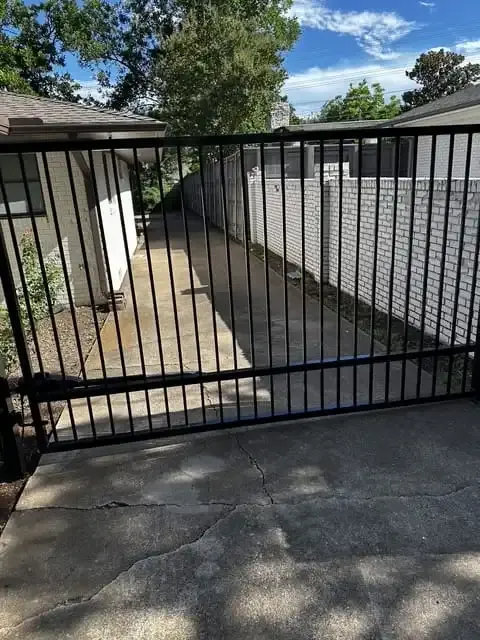
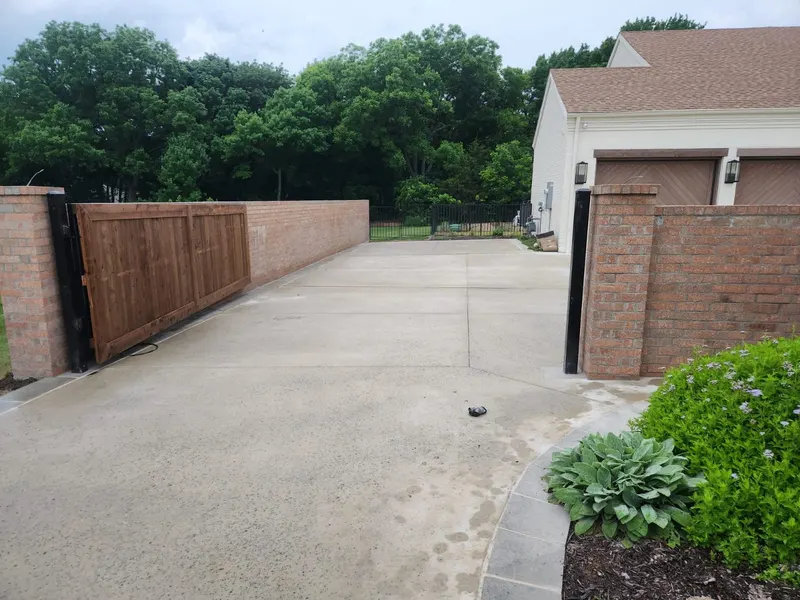
For a side-street driveway gate, the clean answer is to set the gate and its columns back past the triangle, with open iron on the wings. In Dallas that is 20 feet from the curb line along the driveway edge. See driveway gate setbacks, permits and safety rules for the rest.
Which fence design works best on a corner lot while keeping curb appeal?
Treat the lot as three zones and give each its own fence. The corner stays open. The side street beside the house gets something worth looking at. The side street beside the back yard gets the privacy. One material run from end to end is where corner lots go wrong, in the review and in how the house looks from the intersection.
Open iron alone does not solve the corner: none of the three codes exempts an open fence. We use iron just behind the triangle.
| Part of the lot | What we build | Why it works |
|---|---|---|
| The street corner, inside the triangle | No fence. The line is clipped on the diagonal between the points where the triangle crosses your property lines, with low planting in front | The sight band stays clear, and the clip reads as a designed corner |
| Side street beside the house | Powder-coated ornamental steel between brick or stone columns, with an evergreen hedge behind | The street sees iron, masonry and green, and the hedge does the screening |
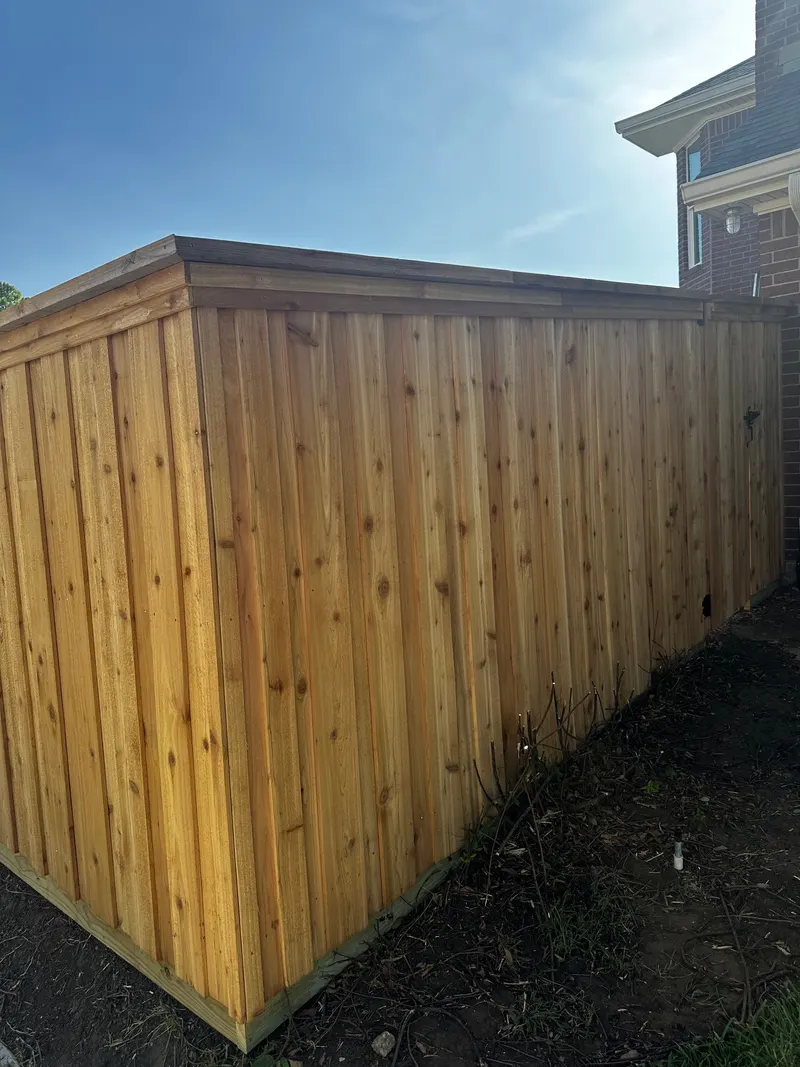
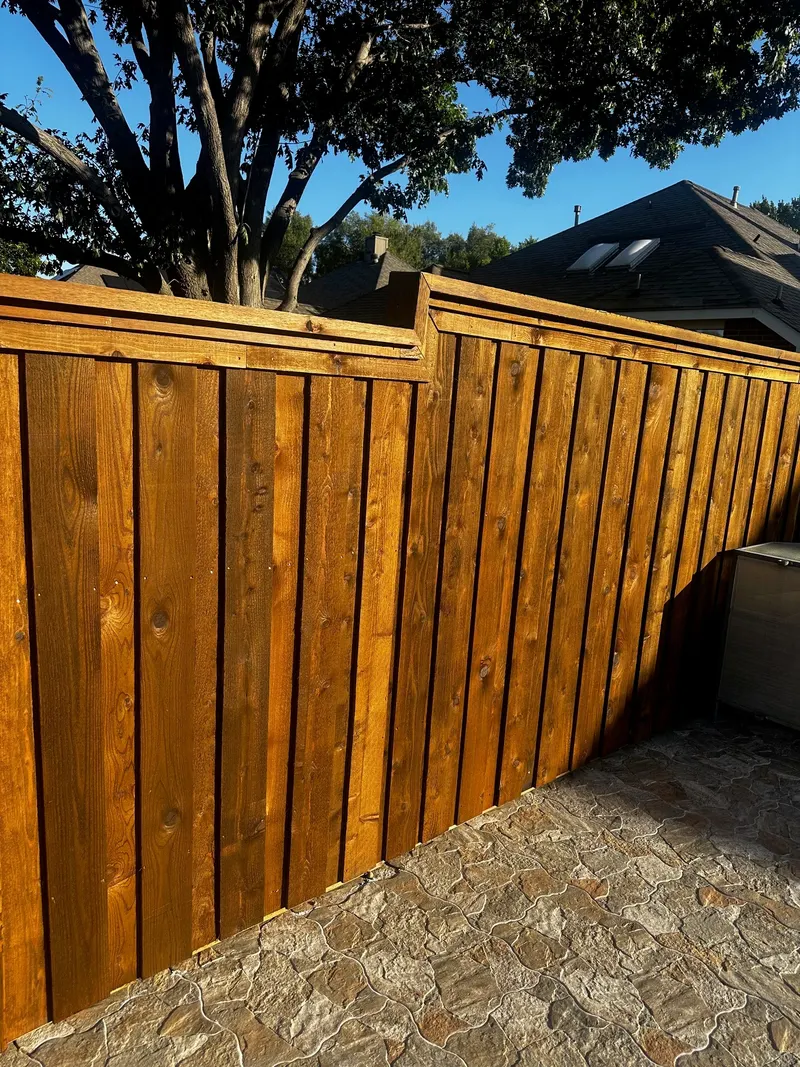
| Side street beside the back yard | Board-on-board cedar with cap and trim at the height your city allows, held back for a planting strip | Full privacy where you sit, with a softer edge toward the sidewalk |
| Back corner at the alley | A second clip, or the last bay kept low, sized to the 20-foot or 15-foot rule | Drivers leaving the alley can see the sidewalk and the street |
| Side-street driveway | Gate and columns set back past the triangle, open iron on the wings | A clear view when backing out |
What this means for you: Plan on two or three fence types that share a color, a cap line and a column detail. It reads as one design from the street and puts the solid fence only where you need it.
Where can the solid privacy run start, and how do slope and planting change it?
The solid run starts at whichever line is farther from the corner: the long edge of the visibility triangle, or the line your city sets for the front of the house. In the Park Cities that second line usually keeps the front corner fence-free already, and the alley corner is the one to watch. In Dallas the triangle is larger and more often cuts into the side-street run itself.
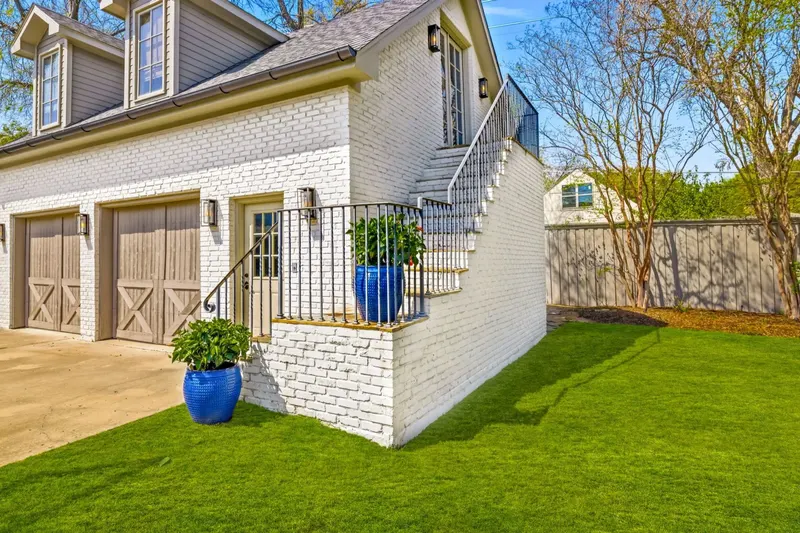
From that point a cedar privacy fence can run to the rear of the lot. Where the first bays sit beside the house and nobody needs screening, we like iron between masonry columns there, changing to cedar at the back corner of the house. The change happens at a column, so it looks planned. See why masonry columns elevate a fence line.
Corner lots often sit above the sidewalk, and each city measures height differently. Dallas measures a side or rear yard fence on the inside. Highland Park measures from the non-owner side. University Park measures from natural grade along the nearest property line, says fences may need to step or slope to stay under the limit, and lets columns rise six inches above the adjoining fence. We step the fence in level bays: see building a fence on a sloped yard.
Planting follows the same triangle in all three cities. A hedge is the right tool for screening behind iron, as we explain in how to add privacy to an iron fence, but it belongs outside the triangle. For more ways to screen a yard without more fence height, see backyard privacy when fence height is limited.
How do we lay out a corner-lot fence before anything is built?
On paper first, with the survey. Dallas asks for visibility triangles to be shown on the fence permit site plan. Drawing the triangles before the fence avoids the redesign that follows when a reviewer draws them for you. The filing steps are in our guides to the Dallas fence permit and Highland Park and University Park permits.
Jack Johnson, our owner, comes out himself for the consultation and is on site for the build and the final walkthrough. Cedar, iron and masonry are all built in-house, so the clip, the columns, the gate and the privacy run are drawn as one plan, and we handle the permit, HOA drawings and the 811 locate. Call (214) 755-8100 or ask for a free written estimate, and we will mark the triangles on your corner before you choose a design.
- Find the curb linesWe measure from where the two curb lines meet and from each driveway and alley edge, not from the property pins.
- Mark the trianglesOn the ground and on the survey, sized for your city.
- Settle front and sideWe confirm with the city which frontage is the front yard and what height applies along the second street.
- Place the fenceSolid cedar behind the triangles and the front line, iron and columns where the street looks in, gates clear of the driveway triangle.
How Park Cities Fence & Deck helps
Jack Johnson comes out himself, looks at your property and gives you a free written estimate with a timeline. Wood, iron and masonry are all built in-house, so the advice fits the property. Related services: iron / metal fencing, privacy fencing, masonry fencing. We work in Dallas and Highland Park and across Dallas.
Questions people ask next
Can I get approval for a fence inside the visibility triangle in Dallas?
There is a route. Section 51A-4.602(d)(3) of the Dallas Development Code says the Board of Adjustment shall grant a special exception to the visual obstruction rules when, in its opinion, the item will not constitute a traffic hazard. That means an application to the board, with no promised result. We also draw a design that stays out of the triangle, so the project does not depend on the board.
Does an open iron fence count as an obstruction in the triangle?
By the text, yes. Dallas bars any structure or other item between two and a half and eight feet high in the triangle, and University Park and Highland Park name fences without separating open ones from solid ones. In Dallas an open fence inside the triangle needs a special exception from the Board of Adjustment. In the Park Cities we keep fences out of the triangle.
Do hedges and trees have to follow the visibility triangle too?
Yes. Dallas lists plant life, Highland Park lists hedges, shrubs and trees, and University Park lists the foliage of hedges, trees, bushes and shrubs. Inside the triangle, planting has to stay below the clear band, which starts at two and a half feet above the curb in Dallas and University Park and at 24 inches in Highland Park. Ask the city before planting anything there that will grow.
My corner fence is older than the rule. Does it have to move?
In Dallas, the code says it is a defense to prosecution that a structure became nonconforming with respect to the visibility triangle, unless those nonconforming rights have been lost or terminated. A replacement fence is new work, so do not assume it may be rebuilt in the same place. We ask the city about your fence before pricing a like-for-like replacement, and we ask the town in Highland Park and University Park.
Sources and further reading
- City of Dallas Development Code, Section 51A-4.602: Fence, Screening and Visual Obstruction Regulations
- City of Dallas Development Code, Section 51A-4.401: Minimum Front Yard (corner lots)
- City of Dallas Planning & Development: Fence Permit, Pool Barrier and Retaining Wall Checklist
- City of Dallas Planning & Development Guide (visibility triangle summary)
- Town of Highland Park Zoning Ordinance (Ordinance 676): Sections 8-402, 8-502 and 15, Fence Regulations
- Town of Highland Park Zoning Ordinance: Appendix Illustration 10, Sight Visibility Easement
- Town of Highland Park, Department of Building Inspection: Fence Permit Packet
- City of University Park Zoning Ordinance, Article 8: Fences, Walls and Screening
- City of University Park Code of Ordinances, Section 12.01.012: Obstructions to sight line at intersections
- City of University Park: Fence Regulations
General information, not legal advice. Rules change: we confirm the current requirements with your city or HOA before we build.